

AV vs Acoustics: Why a Good System Still Sounds Bad

Most of us have been in this situation. The system is installed, everything checks out at the rack, and then the client turns around and says: "I can't hear anything" or "Why does it sound so unclear?"
This is a challenge playing out across India right now. According to AVIXA’s 2024 Industry Outlook and Trends Analysis (IOTA), India is the fastest-growing professional AV market in the Asia-Pacific region. Corporate campuses, co-working spaces, and educational institutions are deploying AV systems at a pace the country has never seen before. But the buildings many of these systems are going into, glass-heavy, hard-surfaced, and built for aesthetics rather than acoustics, are working against the technology from day one.
Before we start second-guessing the equipment, we need to ask the right question first — because these two complaints actually point to completely different problems.
When There's No Sound At All
If the client can't hear anything, or the volume is nowhere near where it should be, this is usually on us. The three most common culprits we see in the field are:
Signal misrouting — audio going to the wrong output or zone because of a DSP routing error or patch bay misconfiguration. Easy to miss during a busy installation, easy to fix once you trace it.
Faulty equipment or cabling — a dead amp channel, a damaged connector, a cable terminated incorrectly. No sound at the speaker doesn't always mean no signal at the rack, so systematic tracing from source to speaker is the right approach.
Insufficient speaker coverage — parts of the room simply don't have a speaker aimed at them. This one starts in the design phase, but it shows up at commissioning.
These are all within our scope to fix. Good troubleshooting methodology will get there every time.
When The Sound Is There But Unclear
This is the one that causes the most friction with clients — and the most confusion within our own teams.
The system is running. The signal is good, the amp is working, the speaker is producing sound. But the client still complains that they can't understand what's being said. At this point, a lot of people's instinct is to start tweaking EQ or repositioning speakers.
Sometimes that helps. Often it doesn't — because the problem isn't the system. It's the room.
Every Room Has Its Own Acoustic AV Character
The materials on the walls, floor, and ceiling determine how sound behaves inside a space — completely independently of our equipment. Hard surfaces like concrete, glass, and gypsum reflect sound rather than absorbing it. So every sound the speaker produces reaches the listener twice: once as the direct signal, and again a moment later as reflections bouncing off the room surfaces.
When those reflections arrive too close to the direct sound, the brain can't separate them. Syllables blur, consonants get lost, and speech becomes difficult to follow — even at a perfectly adequate volume level.
We can measure this behavior using Reverberation Time, or RT60 — the time it takes for sound to decay by 60 dB after the source stops. A room with a high RT60 holds sound in the air too long, and that's where the clarity problem lives.
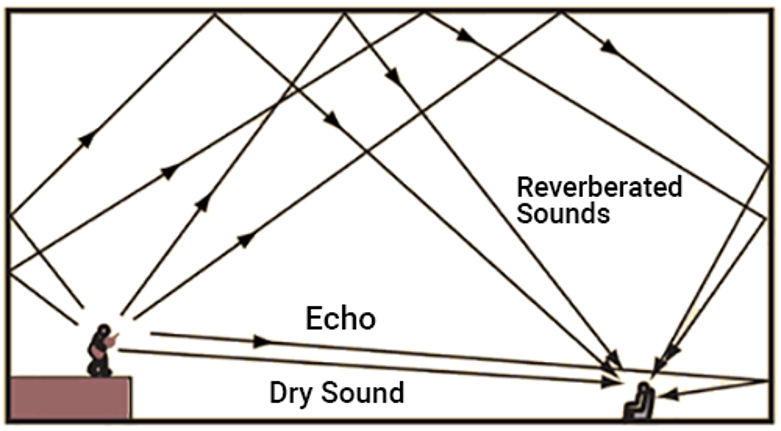
The Chain: RT60 → flutter echo → low STI
These three things tend to appear together, and it helps to understand how they connect.
When RT60 is high, reflections linger. In rooms with two large parallel hard surfaces facing each other — which describes almost every meeting room and corridor we work in — those reflections bounce back and forth rapidly between the walls. This is flutter echo. You've probably noticed it yourself: walk into an empty tiled corridor and speak, and your voice seems to keep going after you've stopped.
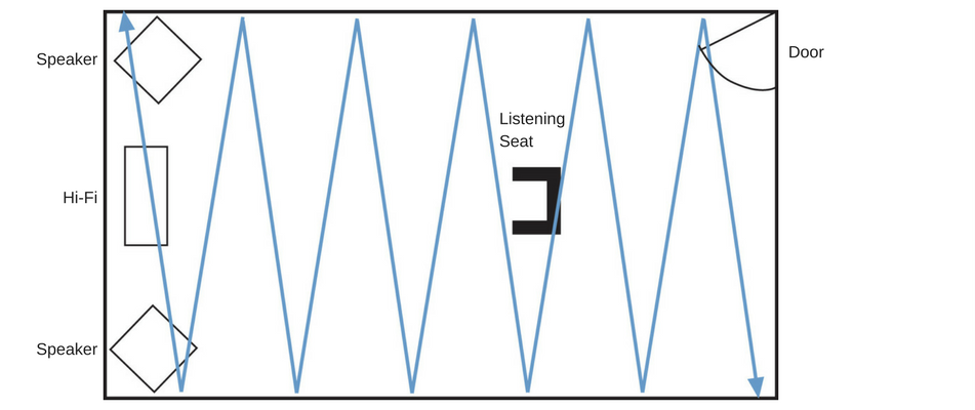
All of this adds up to a low STI score. STI stands for Speech Transmission Index — the standard measurement for how well speech survives a room's acoustic environment, on a scale from 0 to 1. Below 0.5 is considered poor. A room with hard surfaces, high RT60, and flutter echo will score badly on STI, and no amount of AV tuning will push that number up significantly.
What About AEC?
A question that comes up a lot: can't the system's Acoustic Echo Cancellation handle this?
AEC is a genuinely useful feature, especially in conferencing rooms where we need to stop the far-end audio from feeding back into the microphone. But it's designed for a specific job — cancelling the echo of a remote signal at the mic — not for fixing a reverberant room. It doesn't restore speech clarity that the room itself has already destroyed.
This is exactly where the approach at COLCOM makes a difference. Our teams factor in the acoustic environment at the design stage, before a single cable is pulled. For clients across India—whether it’s a corporate boardroom in Mumbai, a training facility in Bengaluru, or a collaboration space in Pune—we look at the room alongside the system. That means specifying the right combination of speakers, microphones, DSP processing, and, where needed, flagging acoustic treatment requirements to the client early. Over 1,000 projects delivered across the country have reinforced one consistent truth: the rooms that work best are the ones where AV and acoustics were planned together.
What This Means For Us On Site
When a client says the system sounds unclear, our first job is to diagnose correctly before we start making changes. Is this an AV issue — EQ, delay alignment, mic placement, DSP settings — or is it a room issue that was never going to be solved by the system alone?
Knowing the difference protects us commercially, helps us have the right conversation with the client, and means we're not spending hours on a commissioning floor trying to tune our way out of a problem that needs acoustic treatment, not AV adjustment.
The room is always part of the system. The sooner we factor that in — ideally before the equipment is ever specified — the better the outcome for everyone.
If you’re planning an AV installation in India and want it to actually perform on the day, COLCOM can help you get it right from the start. We offer end-to-end audio visual integration across meeting rooms, auditoriums, training spaces, and command centers, with offices in Mumbai, Bengaluru, and Pune. Reach us at enquiry@colcom.in or visit www.colcom.in.
Written By-
Denise Djong
ESCO, SG


